Settling Crack Repair
Cracks at door and window corners, along seams and where walls meet ceilings, opened up, taped and refinished.
Settling cracks explained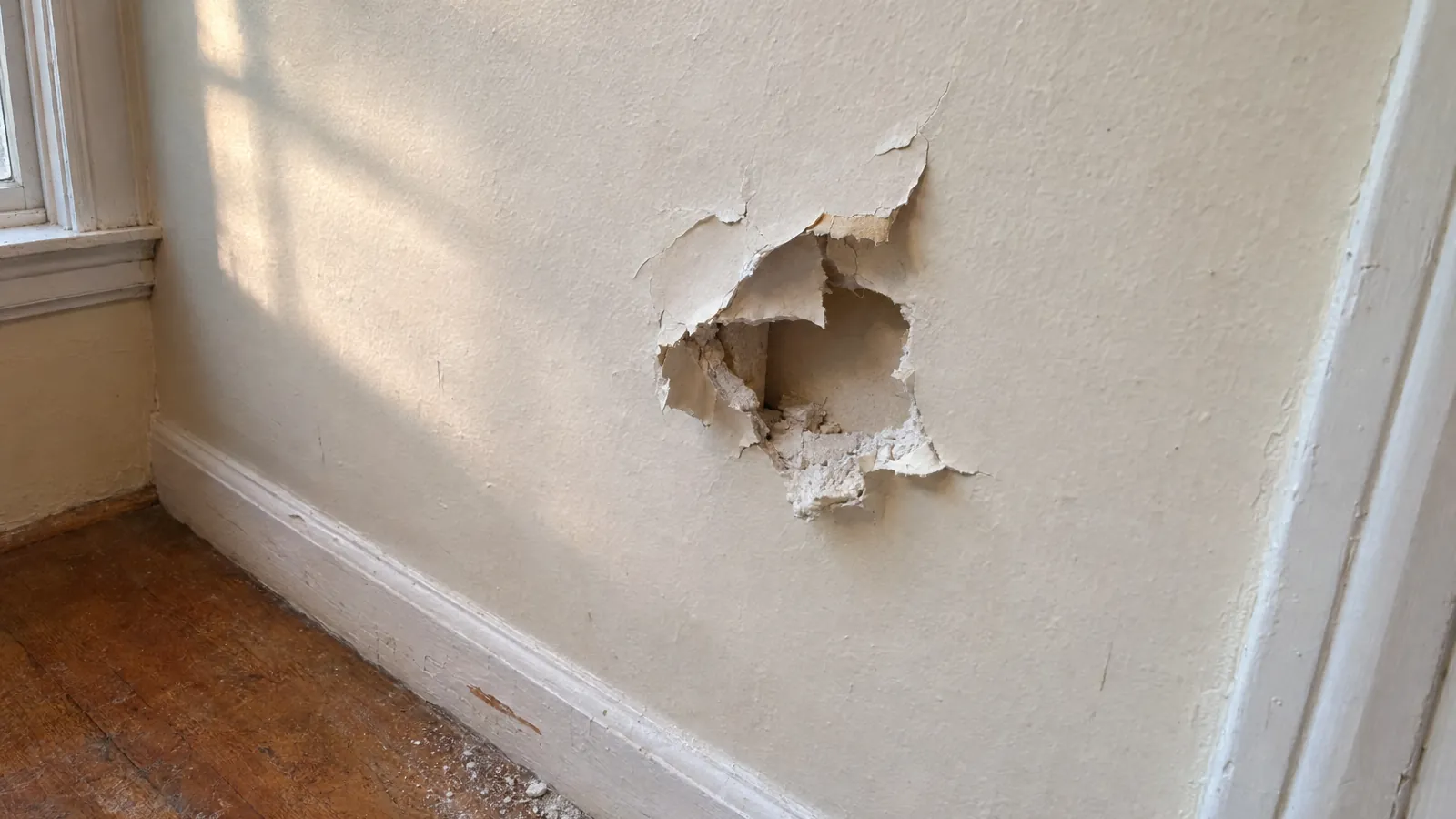
Settling cracks, holes, leak-stained ceilings and tired plaster, put right and finished flush, texture included, so the mended spot does not catch the eye.
Call 7 days, 7am–9pm
Your call is noted in full, and we then set up a pricing call with a local drywall pro at an hour you choose.
Choosing a method
Nearly any damage to a wall or ceiling in a Natchez house can be put right in one of three ways. The choice turns on how large the damage is, what the wall is made of, and whether the surface surrounding it is still sound. The table sets the three methods side by side.
| Criterion | Patch | New panel section | Skim coat |
|---|---|---|---|
| Suited to | Doorknob holes, anchor holes, short cracks, nail pops | Water-weakened board, large holes, drooping ceiling sections | Walls crazed with hairline cracks, earlier repairs or rough texture |
| Size of damage | Roughly palm-sized or smaller | Anything bigger, opened out to the framing | Entire wall or ceiling faces |
| On plaster | Yes, using setting compound | Yes, with the new piece packed out to meet the plaster face | Yes, and often the most sensible choice for crazed plaster |
| Coats and drying | Two or three thin coats | Tape plus three coats, each spread broader | At least two full coats over the whole surface |
| Price depends on | Number of spots, texture | Area replaced, ceiling height, drying | Square footage, preparation, painting afterward |
As a rough yardstick, Fixr's national price guide for drywall work (last revised January 2025) lists a typical repair at around $200 to $550, a single hole at about $60 to $200 and a crack at about $60 to $330. These figures cover the whole country; they are not Natchez prices. A quote for your own wall rises or falls with how much material must be removed, whether texture has to be copied, how high the work sits and the count of separate spots.
After other trades
An electrician running a new circuit through an older house often has to open the wall beside a switch or just below the ceiling line. A plumber reaching a shower valve or a weeping drain cuts a square in the back of a closet. Someone installing heating and cooling equipment may need an opening for a new return, and whoever runs data or television cable leaves small holes beside outlets. Each opening is honest work, and each deserves a proper close.
Done well, the job begins by squaring off the ragged edges so the new piece can sit flat. Where an opening falls between studs, strips of wood are fastened behind the cut edges as backing. A new piece, the same thickness as the wall, is fitted and screwed in; the seams are taped; and thin layers of compound follow, each reaching a little farther out than the one before. The final coat is textured to suit the wall and then primed, so that paint soaks into it evenly with the rest.
Please arrange the wall repair for after any inspection the other trade's work requires. Closing an opening before an inspector has seen it may mean opening it again. Should there be any doubt that the electrician or plumber has finished, we are glad to wait until you confirm it.
Repairs offered
Cracks at door and window corners, along seams and where walls meet ceilings, opened up, taped and refinished.
Settling cracks explainedLoose, bulging or webbed plaster in older houses, fastened back and built up level with the old wall.
How plaster is patchedWater stains, spongy gypsum and drooping sections, dried out, replaced where they have failed, then refinished.
Leak-damaged ceilingsDoorknob holes, anchor holes and impact damage, backed and patched to blend in.
Patching holes in drywallHow it is arranged
A fuller account of how requests are handled is on the page about our work.
For landlords
Renting is common in Natchez. Recent five-year census estimates count about 2,585 renter-occupied homes among roughly 5,856 occupied homes in the city, close to 44 percent. The days between one tenant leaving and the next arriving are therefore a natural time for wall repairs.
Water damage
Natchez summers are hot and wet and its winters mild, the pattern climatologists call humid subtropical, while NOAA's 1991 to 2020 normals put its rainfall near 60 inches in a typical year. Roof flashing, upstairs bathrooms and the drain lines of cooling equipment all have ample opportunity to let water into a ceiling. When that happens, doing things in the right order matters more than haste.
More detail is on the page about repairing a ceiling after a leak.
Keeping a record
Should an insurance adjuster, a landlord or a tenant later ask what happened, a clear record made early repays the few minutes it takes. Coverage is a matter for your policy and your insurer to settle; the points below simply make the facts easy to show.
If you are unsure what the damage means, the care guides walk through the common signs.
Coverage
Work is arranged within the city limits and well beyond them, the Louisiana side of the river included.
A line or two on each community appears on the page listing the places repairs are arranged.
Natchez homes
Recent five-year census estimates (ACS, 2020 to 2024) put the number of homes in Natchez at 7,813, with a median construction year of 1964. Of the homes standing today, 4,367, more than half, went up between 1950 and 1979. Another 1,304 were put up before 1940, and 468 are from 2000 onward. Nearly three in four are detached houses standing on their own lots.
That mix shapes the work. Houses from the 1950s through the 1970s are likely to have drywall, sometimes with a texture or two layered on through decades of repainting. The older houses are far more likely to have plaster over wood lath, which calls for a different approach. The city stands on a bluff above the Mississippi, and the soil of the bluff area is a windblown silt known as loess. Ground that swells and shrinks through wet and dry spells is one common reason a house shifts slightly, and a shifting house tends to show it first as cracks at door corners, window corners and ceiling joints.
Older houses
A plaster wall is built in layers over strips of wood lath, and it clings on by means of keys: plaster pushed between the lath strips that set hard behind them. Once enough keys snap, the plaster parts from the lath and begins to bulge or to crack in a web. Patching over a loose area achieves little, because the area keeps moving.
Careful plaster work begins by fastening the loose plaster back to the lath with screws and broad plaster washers. Cracks and holes are then filled with a setting compound, which hardens through a chemical set and does not depend on drying. Where plaster is missing altogether, new material is built up until it meets the face of the old wall. The page on patching plaster walls goes into this further.
Paint applied decades ago can contain lead. In an older house, please have any painted surface tested before it is sanded or cut, and ask, when the job is priced, what containment will be used should lead turn up.
Arrange a repair
Tell us what has happened to the wall or ceiling, which room it is in and roughly how large it is. A photo, where you have one, helps more than anything else.
Once we have confirmed your details, the pro quoting your repair talks the damage over with you and agrees a figure before anything is touched.